7 Week Three - The Dark Side of Sport
7.1 Introduction
Sport, while showcasing positive aspects of human athleticism and identity, also faces issues of violence and deviant behaviour among both fans and players. This isn’t just raw ‘aggression’, but is often rooted in deeper sociological and cultural contexts.
This week we’ll highlight some historical, sociological, psychological, cultural, and philosophical aspects of ‘bad behaviour’ in sport, focusing specifically on fan violence and athlete deviance.
We’ll also discuss potential strategies for managing and preventing such behaviours in order to ensure both the integrity, and the social value, of sport.
Takeaway
Problems in wider society find their way into sport.
Key Questions
By the end of this week’s lecture, you should be able to answer the following questions:
- Does sport encourage ‘bad behaviour’?
- Why do people behave the way they do?
- What’s the issue with cheating?
- What can be done to address these issues?
Themes
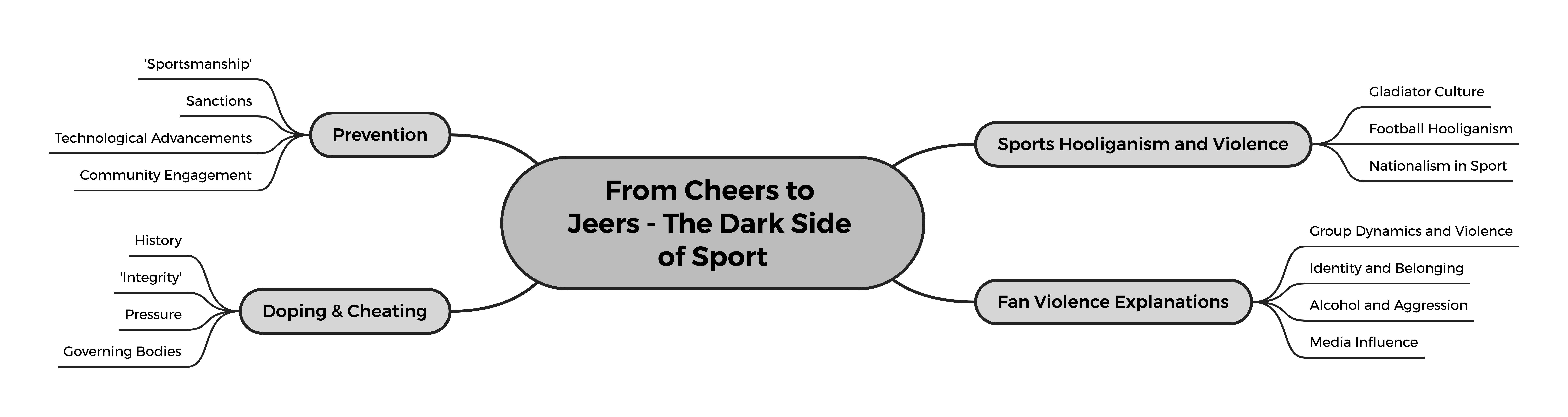
This week’s lecture is organised around four themes:
- Hooliganism and Violence in Sport
- Explanations for Fan Violence
- Doping and Cheating
- Strategies for Prevention
Concepts
Within these four themes, we’ll encounter the following concepts:
Theories
We’ll also learn about the following theories:
7.2 Discussion Questions
In small groups, select one of the following questions and use it as a starting point for a discussion of today’s material. There are some suggestions for things you might talk about.
Question 1
How does the sociological perspective explain the occurrence of violence and deviance in sport, especially among fans and players?
For example, you might consider:
- How do sociological theories explain the role of identity and sense of belonging in contributing to fan deviance?
- To what extent does marginalisation of certain societal groups, such as young men, play a role in sport-related violence? Can you provide examples from other contexts?
- What strategies or approaches might be used to address and reduce the occurrence of this type of behaviour among fans, based on sociological understanding?
Question 2
How can we understand the use of performance-enhancing drugs and on-field violence among athletes from a sociological perspective, and what implications does it have for societal expectations and individual aspirations in sport?
For example, you might consider:
- How does the pressure and high stakes in modern sport contribute to deviant behaviour among athletes, such as using performance-enhancing drugs or engaging in on-field violence?
- How does the desire for recognition and success factor into the decision of athletes to engage in such behaviours?
- How do societal expectations of success and victory potentially influence the values of fair play in sport?
- What could be the role of different stakeholders (e.g., leagues, coaches, the public, the media) in promoting and maintaining the values of fair play, and in discouraging deviant behaviours among athletes?
7.3 Reading
All reading for the module can be accessed via the module reading list on myplace.
Preparatory Reading
You should read the following paper before this week’s lecture:
- Spaaij. (2007). Football hooliganism as a transnational phenomenon: Past and present analysis: A critique - More specificity and less generality. International Journal of the History of Sport, 24(4), 411-431.
Further Reading
You should read the following paper after this week’s lecture:
- Dimmock, & Grove, J. R. (2005). Relationship of Fan Identification to Determinants of Aggression. Journal of Applied Sport Psychology, 17(1), 37-47.
7.4 Lecture Outline
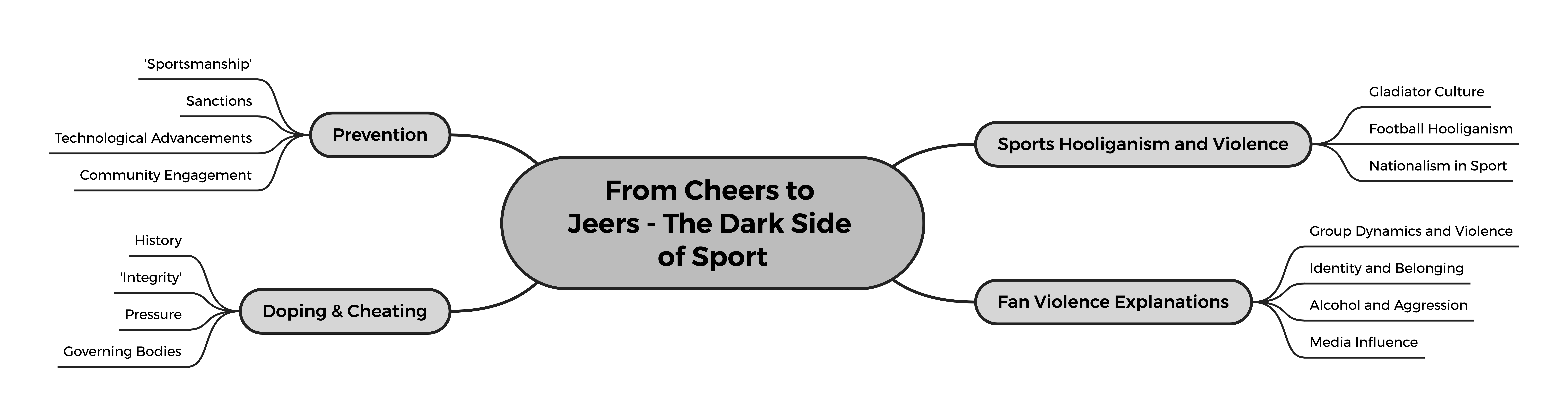
Today’s lecture is structured as follows:
Topic 1: Hooliganism and Violence in Sport
a. Gladiator Culture
Grandeur and brutality
Gladiatorial combat in ancient Rome blended spectacle with violence, glorifying physical prowess and bloodshed.
These events were highly popular, reflecting the Roman Empire’s fascination with dominance and entertainment through conflict.
‘Normalisation’ of violence
The brutality of gladiator events desensitised the public, making violence a normal, accepted part of life.
Roman society came to expect and even demand such violence, which reflected the power dynamics and values of the time.
How does the normalisation of violence in ancient Rome compare to modern-day sports culture?
b. Football Hooliganism
Emergence of football hooliganism
Football hooliganism gained prominence in the 1960s and 1970s, often linked to working-class identity and social unrest.
Groups of fans used matches as opportunities for organised violence, marking the sport as a battleground for pride and territory.
Beyond a ‘game’
Hooliganism transcended the boundaries of the football field, intertwining with cultural and political ideologies.
Violent behaviour became a way to assert identity and dominance, making football a platform for broader societal issues.
Why do some fans feel the need to express identity through violent behaviour at sporting events?
c. Nationalism
Sport, politics, and national identity
International sporting events often stir national pride, where victories are seen as symbolic of a nation’s strength and identity.
This can foster intense rivalries that sometimes manifest as violent outbursts among fans.
Sporting events as proxy wars
Historical rivalries and political tensions between nations can spill over into sport, turning competitions into symbolic “battles.”
The intensity of these matches often reflects underlying geopolitical conflicts, with sport serving as a channel for nationalist expression.
Can nationalism in sports ever be a purely positive force, or does it always carry a risk of inciting division?
Topic 2: Explanations for Fan Violence
a. Group Dynamics and Violence
Emotional intensity of sporting events
Sporting events trigger strong emotions, increasing fan excitement and passion.
Heightened emotional states can lead to irrational or aggressive behavior.
Fans may become more susceptible to collective influence due to the emotional highs and lows.
‘Groupthink’ and its influence in sport
Groupthink leads to suppression of dissenting opinions to maintain group unity.
Fans in groups may adopt extreme behaviour they wouldn’t normally engage in individually.
Creates environment where aggression becomes normalised within the crowd.
Loss of individuality in crowds
Large groups encourage a “deindividuation” effect - personal responsibility diminishes.
Fans may act out due to the perceived anonymity provided by the crowd.
The sense of accountability decreases, fueling collective misbehavior.
Dual nature of group dynamics
Group dynamics can foster both positive (camaraderie) and negative (violence) behavior.
Supportive group behaviour can turn aggressive when faced with provocation or competition.
Fans may shift quickly from cheering to hostility depending on the crowd’s mood.
b. Identity & Belonging
Connection between sport and identity
Sports teams often represent a core part of fans’ personal and social identity.
Fans feel a deep personal connection to the successes and failures of their team.
This identification can heighten emotional reactions, especially when the team is threatened.
Beyond spectating
Fans engage in rituals and social practices beyond watching games, such as tailgating (USA) or chanting.
These practices reinforce group bonds and the sense of belonging within a fan community.
Fandom extends into lifestyle choices, solidifying the sense of identity tied to the team.
Research on fan aggression
Studies show that stronger identification with a team correlates with increased aggression toward rival teams.
Fan aggression is often triggered by perceived threats to their group’s status.
Aggression may serve as a means to protect the fan group’s identity and defend against outsiders.
Factors amplifying aggression
Intense rivalries, losses, or perceived injustice (e.g., bad refereeing decisions) can heighten aggression.
Social factors, such as peer pressure or gang-like loyalty within fan groups, intensify violent reactions.
Environmental factors like stadium design or crowd control measures may also play a role in escalating violence.
c. Alcohol and Substance Abuse
Alcohol and identity
Drinking is often seen as part of the fan experience, enhancing group cohesion.
Alcohol consumption can act as a social ritual that reinforces fan identity.
The behavior and attitudes surrounding drinking culture can encourage more extreme fan behavior.
Catalyst for fan violence
Alcohol lowers inhibitions and impairs judgment, leading to impulsive actions.
Fans under the influence may be more likely to engage in confrontational or violent behavior.
Substance abuse can intensify reactions to in-game events, triggering altercations.
Academic insights
Research shows that alcohol consumption is a significant predictor of fan violence, particularly in high-stakes games.
Studies link alcohol to both verbal aggression and physical altercations in stadiums.
Psychological theories suggest that intoxication alters risk perception, making violence seem less consequential.
Other contributors
Factors like high stress, competition, and crowding may interact with alcohol to provoke violence.
The presence of other drugs, such as stimulants, can further increase aggression among fans.
Peer pressure and a desire to conform to group expectations play significant roles in violent outbreaks.
d. The Magnifying Glass
Magnifying effect of media on fan violence
Media coverage often exaggerates fan violence, making it appear more widespread than it is.
High-profile incidents receive disproportionate attention, shaping public perceptions.
The media’s focus on fan violence can create a self-fulfilling prophecy, encouraging copycat behavior.
Research on media portrayal and fan behaviour
Studies show that sensationalised media reports can increase fear and anxiety about attending events.
Media framing of fans as violent or unruly may lead to greater policing and stricter security measures.
Fans may internalise media narratives, viewing violence as a natural or expected part of the sporting experience.
Selective media focus
Media often highlights negative fan behaviour while ignoring peaceful or celebratory aspects of fandom.
The selective focus on violence skews the public’s understanding of fan culture.
This selective reporting can lead to a distorted view of the frequency and severity of fan violence.
Topic 3: Doping & Cheating
a. History
Historical context of doping
Doping in sports has ancient roots; athletes used substances to enhance performance as early as the Olympic Games in ancient Greece.
Modern doping evolved alongside advancements in medical science, with the use of synthetic drugs like steroids becoming more widespread in the 20th century.
Public awareness and regulatory actions have developed in response to high-profile doping scandals across various sports.
Evolving nature of doping
New methods of doping constantly emerge as scientific advancements create more sophisticated ways to enhance performance.
Athletes and teams now exploit biological manipulation (e.g., blood doping, gene doping) in addition to traditional performance-enhancing drugs.
Governing bodies face the ongoing challenge of keeping up with these evolving techniques to ensure fair competition.
Ancient vs. modern doping
Ancient athletes used basic stimulants like herbal concoctions or wine, while modern doping involves complex chemicals and biological methods.
The intent remains the same - gaining a competitive edge - but methods and consequences have grown more significant over time.
Modern doping carries more ethical, health, and legal implications, reflecting a shift in societal attitudes toward fairness and health risks.
Ethics and the morality of doping
Doping challenges the core ethical values of fair play, integrity, and honesty in sport.
Athletes who engage in doping violate the trust of their competitors, fans, and the sporting community.
The moral debate over doping often centers on whether performance enhancement undermines the true spirit of competition.
b. Integrity
Ethical foundation of sport
Sport is built on principles of fairness, where competitors agree to play by the same set of rules.
Integrity in sport creates a level playing field, essential for maintaining public trust and engagement.
Without integrity, sport loses its value as a symbol of human achievement and merit.
Ramifications of betraying trust in sport
Athletes caught doping not only damage their own reputations but also taint the legitimacy of their sport.
Betraying trust results in lost sponsorships, reduced fan engagement, and diminished career prospects for the athlete.
The entire sporting community may suffer as fans grow disillusioned with perceived widespread cheating.
Fragile nature of trust in sport
Trust between athletes, fans, and governing bodies is delicate and easily broken by scandals or rumors of doping.
Once trust is broken, it is challenging to restore, requiring years of effort and transparency to rebuild confidence.
Even suspicion of doping can undermine the legitimacy of an athlete’s achievements or an entire sporting event.
Long-term impact of doping on sport
Doping scandals leave a lasting mark on sport, affecting viewership, sponsorship, and overall reputation.
Long-term consequences include stricter testing regimes, increased surveillance, and a culture of suspicion in professional sport.
In some cases, entire generations of athletes or sports may become associated with doping, tarnishing their legacies.
c. Pressure
Societal expectations and athlete behaviour
Athletes face immense pressure to win, often driven by societal expectations, sponsorships, and media scrutiny.
This pressure can push athletes toward unethical practices like doping to meet these high standards of performance.
Fans, sponsors, and the media play a role in shaping the extreme expectations placed on athletes.
Ethical cost of achievement
The pursuit of victory at any cost can lead athletes to compromise their values and integrity through doping.
The temptation to cheat grows when the rewards for success - fame, fortune, prestige - outweigh the consequences of being caught.
Athletes may struggle with balancing their personal ethics against the overwhelming desire to succeed in a competitive environment.
Societal measurement of ‘success’
Society often measures an athlete’s success purely by their victories and records, ignoring the process and effort involved.
This emphasis on winning at all costs contributes to a culture where doping can be seen as a ‘necessary evil’ to meet these expectations.
Celebrating the journey of sportsmanship and personal growth could help reduce the pressure to resort to unethical means.
Way forward…
A shift in societal values toward celebrating effort, discipline, and personal improvement could help mitigate the pressure to cheat.
Increasing education about the consequences of doping, both health-wise and ethically, is critical to discouraging athletes from engaging in it.
Creating support systems that help athletes cope with pressure and stress may foster a healthier, more ethical sporting culture.
d. Governing Bodies
Role of governing bodies
Governing bodies like WADA (World Anti-Doping Agency) set and enforce rules to combat doping, ensuring fair play in sports.
These organisations conduct testing, impose penalties, and promote anti-doping education to maintain the integrity of competition.
Their role is crucial in upholding the standards of fairness across national and international sporting events.
Understanding sport governance
Governance involves creating frameworks that protect athletes, promote ethical behaviour, and ensure consistent rules are followed.
Good governance emphasizes transparency, accountability, and the consistent enforcement of anti-doping regulations.
Governing bodies must balance strict control with the autonomy of sports organizations and athletes.
Broader context of regulatory governance
Regulatory governance in sports involves a network of stakeholders, including national governments, sponsors, and international bodies.
The global nature of sport requires cross-border cooperation in testing, regulation, and punishment for doping offenses.
Issues like funding, jurisdiction, and consistency of enforcement make governance in doping a complex and ongoing challenge.
Challenges and significance of governance
Governing bodies face challenges like detecting new forms of doping, managing athlete privacy, and ensuring tests are fair.
Athletes may exploit loopholes or the lack of uniformity in regulations across countries and sports.
Effective governance is crucial for maintaining public trust and ensuring that sports remain fair and competitive for all participants.
Topic 4: Strategies for Prevention
a. Sportsmanship
Education & awareness
Promoting sportsmanship through education ensures athletes understand the importance of ethical behaviour both on and off the field.
Awareness programs can emphasise the long-term value of integrity, fair play, and respect in sport, fostering a positive sporting culture.
Sportsmanship: ethical sporting conduct
Ethical conduct in sport promotes fairness, respect for opponents, and adherence to the rules, essential for preserving integrity of competition.
Athletes who model sportsmanship can inspire others, creating a ripple effect that enhances the overall sporting environment.
How can we ensure that sportsmanship remains a core value in a culture increasingly focused on winning?
‘Ripple effect’ of athlete behaviour
The behavior of professional athletes can influence younger athletes, fans, and entire communities, making ethical role models crucial.
Positive actions, such as showing respect in defeat, can set an example that extends far beyond the game itself.
Beyond wins and losses
True sportsmanship values effort, teamwork, and personal development over simply winning, encouraging a more holistic view of success.
Shifting focus away from results and toward personal growth can create a healthier, more inclusive sports culture.
b. Sanctions
Education in sporting ethics
Sanctions serve as a tool for reinforcing ethical standards by holding athletes accountable for misconduct.
Education about sanctions can deter unethical behaviour by demonstrating the consequences of violating sporting codes of conduct.
The power and purpose of sanctions
Sanctions act as both punishment and deterrent, aiming to maintain the fairness and integrity of sport.
When consistently applied, they help foster a culture of accountability and respect for the rules.
General Deterrence Theory
General Deterrence Theory suggests that clear, consistent punishment for infractions can prevent future violations by discouraging similar behavior in others.
Visible sanctions can reinforce the idea that ethical breaches are taken seriously and have consequences.
Are sanctions alone enough to deter unethical behaviour in sports, or do they need to be paired with broader cultural shifts?
c. Technological Advancements
Evolution of technology in sport
Technology, such as VAR (Video Assistant Referee), has transformed how fairness and accuracy are upheld in modern sport.
Advanced tools help minimise human error, providing a more precise and objective way to monitor rules and behaviour in real time.
Emotional impact of VAR
While VAR has improved the accuracy of decisions, it can disrupt the emotional flow of the game, affecting both players and fans.
Delays in decision-making and the uncertainty introduced by technology can create frustration and impact fan experience.
Can the benefits of technological accuracy in sport outweigh the emotional costs to the fan experience?
d. Community & Fan Engagement
Transformative power of fans
Fans play a critical role in shaping the culture of sport, with their behaviour influencing both the atmosphere in stadiums and the wider perception of sporting events.
Engaging fans in positive ways, such as through community initiatives, can shift the focus toward unity, respect, and shared experiences.
An inclusive sporting culture
Building an inclusive culture that embraces diversity can help reduce aggression and promote sportsmanship among fans.
Inclusivity fosters a sense of belonging and respect, where all fans feel valued and encouraged to support their teams positively.
How can sporting organisations involve fans more effectively to foster a positive, inclusive atmosphere at events?