4 Theories
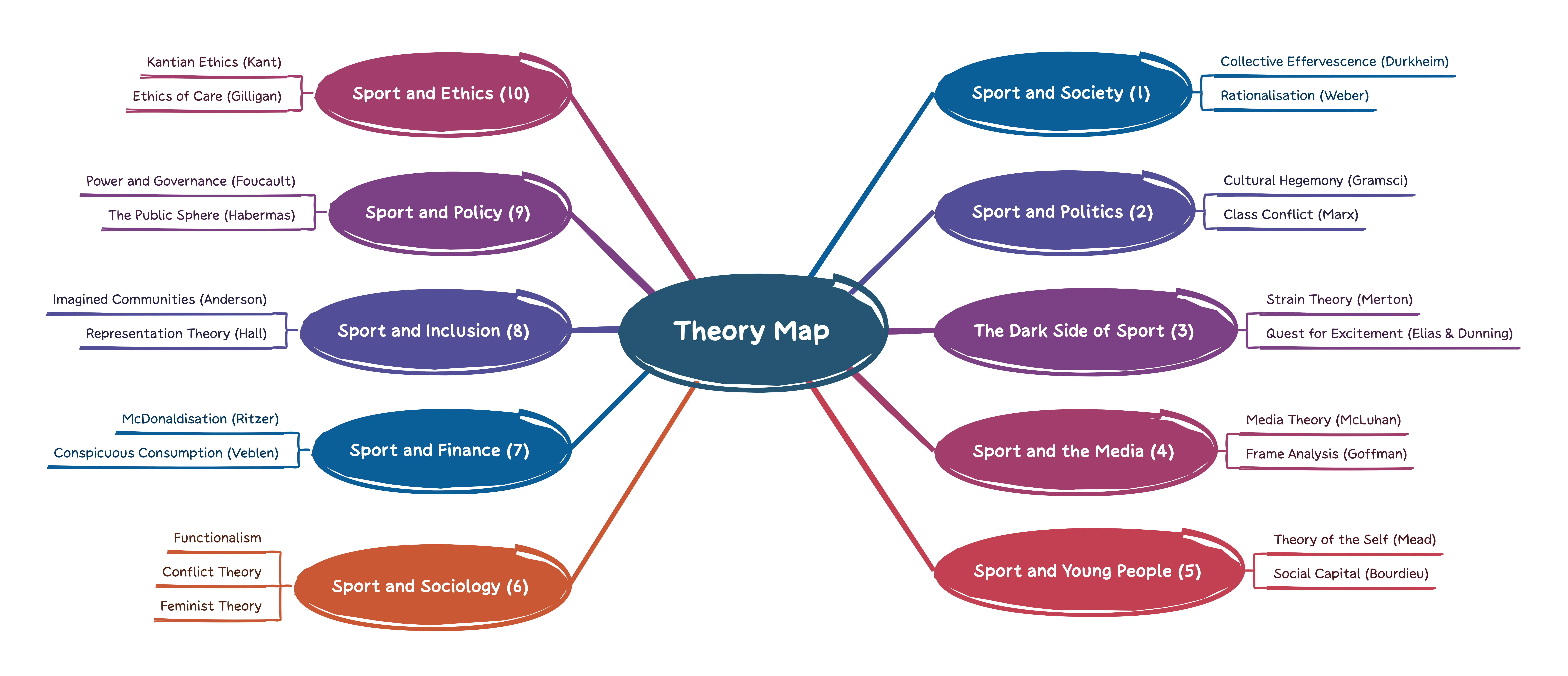
4.1 Week One - Sport and Society
Collective Effervescence (Durkheim)
Durkheim’s theory of ‘Collective Effervescence’ helps us understand that sport serves as a ritual that promotes social solidarity, particularly in large-scale events like the Olympics.
The theory explains the heightened sense of energy, unity, and shared emotion experienced by a group of people during communal rituals or events.
This phenomenon occurs when individuals come together and participate in collective activities, leading to feelings of transcendence and connection to a greater ‘whole’.
Collective Effervescence reinforces social bonds and shared values, thus playing a crucial role in maintaining social cohesion and the collective conscience of a community.
Rationalisation (Weber)
Weber’s theory of ‘Rationalisation’ can be applied to the historical transformation of sport from traditional, communal activities to modern, organised sport that emphasises efficiency and predictability.
In Weber’s model, rationalisation refers to the process by which traditional and spontaneous modes of thinking and acting are replaced by a focus on efficiency, predictability, and control.
This transformation is characterised by the systematic and methodical organisation of social, economic, and cultural life, often epitomised by bureaucratic form of organisation.
Rationalisation can lead to a disenchantment with the world as mystical and religious explanations give way to rational and scientific reasoning.
It involves the increasing dominance of reason and logic in human affairs, with the aim of achieving maximum efficiency and effectiveness in various aspects of life.
4.2 Week Two - Sport and Politics
Cultural Hegemony (Gramsci)
Antonio Gramsci’s idea of ‘cultural hegemony’ is useful in analysing how sport serves as a cultural ‘arena’ where hegemonic ideas (e.g., nationalism) are reinforced or contested.
Cultural hegemony describes how, in capitalist societies, states use cultural institutions to maintain power. Instead of dominating purely through force, the ruling class - those who control the economic systems - manipulate the culture and norms so that their values are seen as the universal norm. This cultural hegemony promotes the interests of the ruling class as the interests of all, even if this is not actually the case.
The population consents to this dominance, often unknowingly, because these values are embedded in everyday practices and media.
Cultural Hegemony is therefore helpful in understanding how power and control are maintained not only through political and economic systems, but also through cultural means, such as sport.
4.3 Week Three - The Dark Side of Sport
Strain Theory (Merton)
Robert Merton’s Strain Theory explains how societal structures can pressure individuals to commit deviant or criminal acts. In the context of sport, it has been used to explain fan violence and other forms of deviance in sport, specifically looking at how societal pressures can lead to norm-breaking behaviour.
According to Merton, society sets out culturally approved goals and provides institutional means to achieve these goals. However, when there is a disjunction between these goals and the means available to individuals, it creates a strain or pressure.
Merton identifies five ways individuals may respond to this strain:
Conformity: Individuals accept both the goals and the means, even if they’re not successful.
Innovation: Individuals accept the goals but use illegitimate or illegal means to achieve them.
Ritualism: Individuals give up on achieving the goals but still adhere to the means.
Retreatism: Individuals reject both the goals and the means, opting out of the striving altogether.
Rebellion: Individuals reject both the existing goals and means, seeking to replace them with new ones.
This theory highlights how variations in social structure can lead to different forms of deviant behaviour, particularly in situations where access to socially approved means of achieving success is unequally distributed.
Quest for Excitement (Elias & Dunning)
Norbert Elias and Eric Dunning’s “Quest for Excitement” explores the thrill-seeking behaviour of spectators, and its potential role in explaining violence that might occur within the context of sporting events.
Elias and Dunning argue that activities such as sport provide structured opportunities for controlled excitement and emotional arousal, fulfilling psychological and social needs that are often constrained in daily life.
Through sport - whether watching or engaging - individuals experience tension and release in a socially acceptable manner, which helps maintain social order and cohesion.
4.4 Week Four - Sport and the Media
Media Theory (McLuhan)
Marshall McLuhan’s media theory posits that the medium through which information is conveyed is as significant, if not more so, than the content itself.
In sport, the transformation of consumption with the advent of new media technologies has resulted in a significant increase in the role of the media in how we encounter and understand sport.
McLuhan famously stated that “the medium is the message.” This highlights how media shapes human experiences and societal structures. He argued that different media technologies (print, radio, television, etc.) influence the way people perceive and interact with the world, leading to profound changes in social organisation and culture.
McLuhan’s work emphasises the transformative power of media in shaping collective consciousness and societal evolution, which applies equally to contemporary sport.
Frame Analysis (Goffman)
In contemporary sport, the media often frames influence our perception of different sports, athletes, and national identities.
Erving Goffman’s ‘frame analysis’ explores how individuals organise their experience and structure their perceptions of the world. “Frames” are the cognitive structures that guide interpretation and understanding of events and interactions.
Goffman proposed that social reality is constructed through these frames, which individuals use to make sense of their environment and to communicate effectively.
By examining how frames are constructed and maintained (for example, in sport), Goffman’s work provides insights into the dynamics of social interaction and the processes through which meaning is negotiated and shared in everyday life.
4.5 Week Five - Sport and Young People
Theory of the Self (Mead)
Mead’s theory of the self explores how individual identities are formed through social interactions.
Mead argues that the self is not present at birth but develops over time through social experiences and activities. He emphasises that understanding oneself comes from the ability to adopt the perspective of others.
Mead outlines several key components in the development of the self:
Preparatory Stage: Young children mimic or imitate others, mostly family members, without understanding the meaning behind their actions.
Play Stage: As children grow, they begin to play roles and adopt the perspectives of significant others (like parents or heroes), which teaches them to see themselves through the eyes of others.
Game Stage: At this more advanced stage, children play organized games and must understand and anticipate the roles of multiple others. This stage introduces them to the concept of the “generalized other,” a composite of societal expectations and attitudes they must embody to function in society.
Generalised Other: This concept represents the organized community or social group which gives individuals their unity of self. By internalizing the generalized other, individuals learn to apply societal norms and expectations to their actions.
Mead’s theory illuminates how the self is a social construct derived from and developed through communicative social interaction, emphasizing the societal rather than biological origins of individual identity.
4.6 Week Seven - Sport and Finance
McDonaldisation (Ritzer)
George Ritzer’s concept of “McDonaldization” describes the process by which the principles of the fast-food industry have come to dominate other sectors of American society and the rest of the world. The theory is rooted in Max Weber’s ideas about rationalisation and bureaucracy. Ritzer identifies four primary components of McDonaldisation:
Efficiency: The optimal method for accomplishing a task. In McDonaldised systems, every aspect of the process is geared towards maximising efficiency, reducing the time between tasks to increase productivity.
Calculability: Quantitative aspects of products sold, and services offered, are emphasized, allowing for everything to be counted, calculated, and quantified. Larger quantities are seen as a sign of value, and service is delivered on a quantitative rather than qualitative basis.
Predictability: Services and products are standardised. This ensures that a product or service will be the same no matter where or when it is purchased.
Control: The substitution of more predictable non-human labour for human labour, either through automation or the scripting of worker behaviour, is a key feature of McDonaldised systems.
Ritzer argues that while McDonaldisation makes tasks easier and more efficient, it also results in negative consequences such as dehumanization, decreased quality, and diminished creativity. This theory critically assesses the impact of industrial logic on contemporary life, emphasising the trade-offs between efficiency and other human values.
Conspicuous Consumption (Veblen)
Veblen’s theory of ‘Conspicuous Consumption’ offers a social critique of consumer behaviour among the affluent. It explores the ways in which people use consumption to signal social status and prestige.
Key aspects of the theory include:
Conspicuous Consumption: This refers to the spending of money on and the acquisition of luxury goods and services to publicly display economic power—both the actual consumption and the visible possession itself are important. It’s not just about enjoyment of the goods, but about showcasing wealth and social status through their possession.
Conspicuous Leisure: Associated with conspicuous consumption, this concept involves visibly engaging in leisure activities that are not economically productive, but instead signify the ability to afford long periods of leisure, suggesting a life free from labour.
Social and Psychological Motivations: Veblen suggests that this behaviour is driven by both social and psychological needs, including the desire for prestige, envy of those who have more, and the need to distinguish oneself from lower social strata.
Veblen’s critique highlights how economic behaviour is not merely about utility or efficiency, but is also a form of social communication that reinforces social distinctions and class divisions. This theory is particularly relevant in understanding consumerism in modern capitalist societies, where the display of wealth often takes precedence over actual utility or personal fulfilment.
4.7 Week Eight - Sport and Inclusion
Imagined Communities (Anderson)
Benedict Anderson’s idea of ‘imagined communities’ can help explain how national teams in international sports competitions create imagined communities among fans.
Anderson argued that nations are socially constructed entities, or “imagined communities,” because the members of even the smallest nation will never know most of their fellow-members, meet them, or even hear of them, yet in the minds of each lives the image of their communion.
This shared sense of identity and belonging is fostered through various means such as language, print media, education, and symbols like flags and anthems. These elements help create a collective consciousness that binds individuals together as part of a nation.
Anderson’s concept has been influential in understanding nationalism, identity formation, and the role of cultural and media practices in shaping modern nation-states.
Representation Theory (Hall)
Stuart Hall’s representation theory investigates how individuals and groups use various forms of representation, such as language, images, and media, to construct and communicate their identities and experiences. Hall emphasises the power of representation in shaping perceptions, reinforcing stereotypes, and influencing social relations. His work highlights the role of representation in education and literacy, examining how different modes of expression can either empower or marginalise individuals within society.
4.8 Week Nine - Sport and Policy
Power and Governance (Foucault)
Michel Foucault’s ideas on power are useful when we analyse the ways in which sporting organisations wield significant power and regulate athletes’ bodies and conduct.
Foucault’s theory of power and governance explores how power is exercised through societal institutions, discourses, and practices. He argues that power is not merely top-down or repressive but is pervasive and productive, shaping knowledge, behaviour, and social norms.
Foucault introduced the concept of “governmentality” to describe the various ways in which individuals are governed and self-regulated through techniques of power that operate at multiple levels of society, from state policies to everyday interactions.
Public Sphere (Habermas)
The concept of the ‘public sphere’ is helpful when we wish to understand how sporting arenas or stadia function as public areas where societal issues are debated and contested.
Habermas’ concept of the public sphere refers to an arena of discourse where individuals come together to discuss and deliberate on matters of common interest, free from the influence of state and market forces. The public sphere is essential for democratic participation and the formation of public opinion.
In his writing, Habermas emphasised the importance of rational-critical debate in this space, where citizens engage in reasoned arguments to influence political decision-making. His work recognises the importance of communication and dialogue in fostering democratic governance and social integration.
4.9 Week Ten - Ethical Dilemmas in Sport
Kantian Ethics (Immanuel Kant)
In sport, Immanuel Kant’s deontological ethics can be used to discuss the moral principles that underpin fair play and sportsmanship, which are common expectations of amateur and professional sport.
‘Kantian Ethics’, developed by Immanuel Kant in the late 18th century, is a cornerstone of modern moral philosophy centred around the concept of duty, rationality, and the intrinsic worth of individuals. Kant introduced his ethical system primarily in his works “Groundwork for the Metaphysics of Morals” and “Critique of Practical Reason.”
Key principles of Kantian Ethics include:
Duty and Good Will: According to Kant, the only thing that is good without qualification is a “good will.” Actions are morally right not because of their outcomes but because they are performed out of a sense of duty. The motive of duty supersedes personal inclinations or desires.
Universalisability (Categorical Imperative): Kant’s central philosophical concept is the categorical imperative, which acts as a test for determining the morality of a particular action. The most famous formulation of the categorical imperative is: “Act only according to that maxim whereby you can, at the same time, will that it should become a universal law.” This means one should only act in a way that one would want everyone else to act in the same situation.
Treat Humanity as an End in Itself: Another formulation of the categorical imperative is to treat humanity, whether in oneself or in others, always as an end and never as a means only. This principle emphasizes the value of every human being as an autonomous individual capable of making rational decisions.
Autonomy and Rationality: Kant believed that moral agents are autonomous and must make decisions based on reason, not emotions or external pressures. The ability to reason and apply the categorical imperative is what gives actions moral worth.
Kingdom of Ends: Kant envisioned a moral community, called a kingdom of ends, where all individuals act in accordance with the categorical imperative, treating one another with dignity, justice, and respect.
Kantian Ethics has shaped contemporary discussions on morality, ethics, and the duties and rights of individuals. It appeals to the rational, autonomous nature of human beings and stresses adherence to consistent moral principles that apply to all rational beings.
Ethics of Care (Gilligan)
Carol Gilligan introduced the Ethics of Care as a distinct moral perspective that emerged from her criticism of Lawrence Kohlberg’s stages of moral development. She argued that Kohlberg’s model was overly focused on justice, rights, and abstract principles, and largely reflected a male perspective, thereby underrepresenting the moral reasoning of women.
Key aspects of Gilligan’s Ethics of Care include:
Relationships and Context: Moral decisions are best understood within the context of human relationships. Gilligan argued that ethical actions flow from people’s connections to others, focusing on maintaining relationships and responsibilities rather than abstract obligations.
Responsiveness to Needs: The Ethics of Care prioritises attentiveness to the needs of specific individuals with whom one has a direct and tangible relationship. It emphasizes understanding and responding to these needs rather than adhering strictly to impartial rules or abstract rights.
Empathy and Compassion: Gilligan’s approach places a significant emphasis on empathy, suggesting that moral insight arises from the ability to put oneself in another’s place and to consider their experiences and feelings.
Moral Pluralism: The Ethics of Care recognises multiple ways of knowing and different types of moral challenges, suggesting that there is often not a single correct answer to moral problems. but a variety of responses shaped by the relational context.
Gilligan’s theory has been influential in broadening the scope of moral philosophy to include not just justice-based approaches, but also those that emphasise care and responsibility.
Social Class Conflict (Marx)
Class conflict refers to the struggle between different social classes, primarily the working class (proletariat) and the ruling class (bourgeoisie), over control of resources and power. This conflict arises from the inherent inequalities in capitalist societies, where the ruling class exploits the working class for profit.
In sport, class conflict can be seen in issues such as access to facilities, representation, and the commercialisation of sports. It helps analyse how economic disparities and power dynamics influence participation, fan bases, and the overall structure of sporting institutions.